Drip Vitals Logo
Login

Weight Loss

Treatments

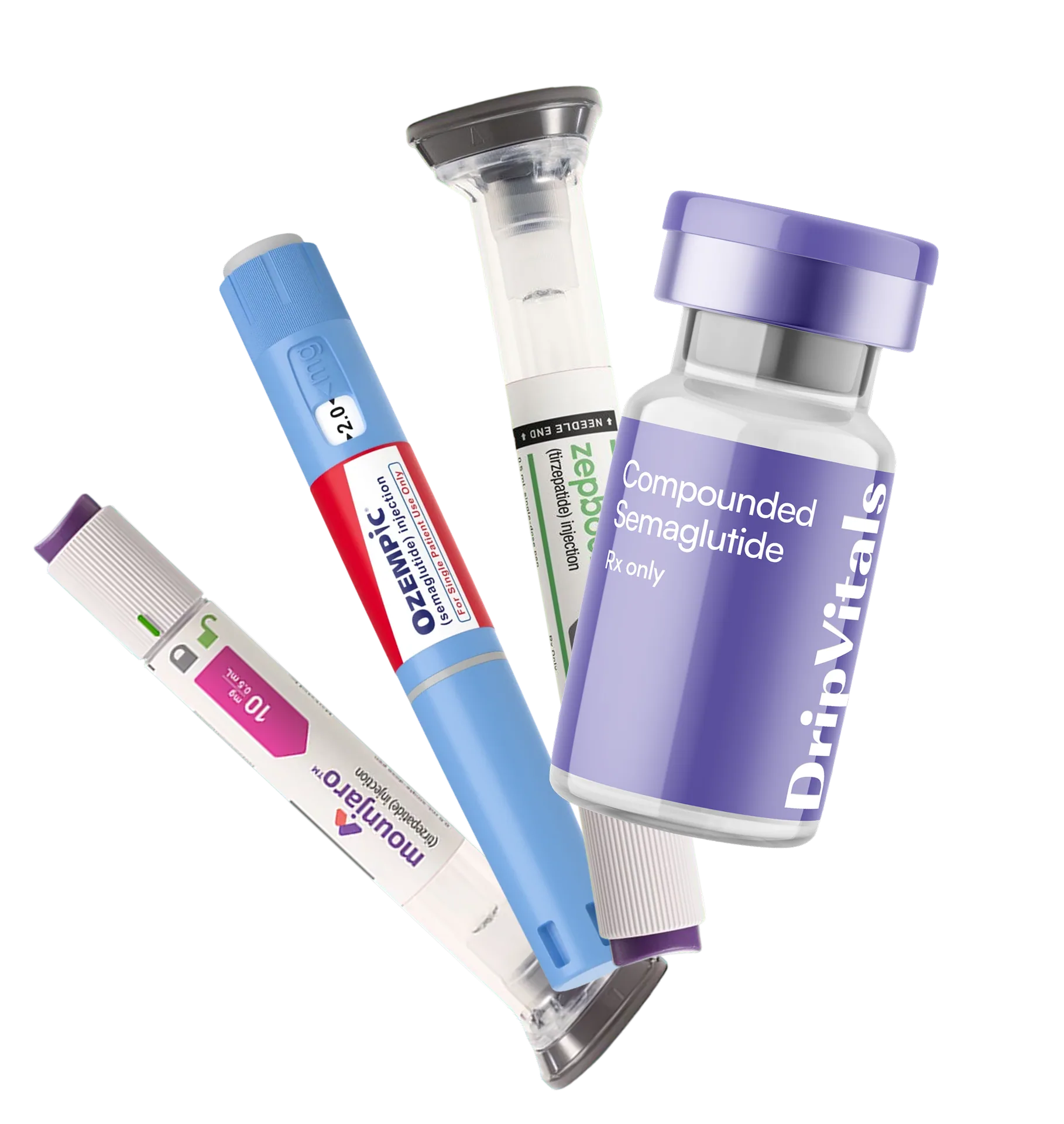
GLP-1 TreatmentsCustom Weight Loss KitOzempic®Zepbound®Mounjaro®Wegovy®Compounded SemaglutideCompounded TirzepatideOral SemaglutideOral Tirzepatide

Get Started

Personalized GLP-1 Treatments

From $199 first month

Get Started

Treatment categories

Get started

Personalized GLP-1 Treatments

From $199 first month

Get Started
Drip Vitals

Sign up to receive health tips.

By subscribing you agree to our Privacy Policy and provide consent to receive updates from our company

Popular

GLP-1 Treatments
Ozempic®
Wegovy®
NAD+
Sermorelin ODT

Company

About Drip Vitals
Drip Vitals Meals
Our Blog
Contact Us
Careers

Legal

Terms & Conditions
Privacy Policy
My Health My Data Privacy Policy
Important Safety Information

Sign up to receive health tips.

By subscribing you agree to our Privacy Policy and provide consent to receive updates from our company

US FDA
US FDA

Compounded

in the U.S.A

©️ 2026 Drip Vitals LLC. All rights reserved.

Drip Vital’s BMI Calculator: Your Guide to Body Mass Index on Your Weight Loss Journey

If you’re on a weight loss journey, you’ve probably heard about Body Mass Index (BMI). It’s a simple measure that can help you understand where you stand in terms of weight relative to your height. In this guide, we’ll explain what BMI is, how it’s calculated, and how to interpret your BMI category – whether that’s underweight, normal, overweight, or obese. We’ll also discuss the benefits and limitations of BMI as a health metric, so you know exactly what this number can (and can’t) tell you. Importantly, we’ll introduce Drip Vital’s free BMI Calculator, a handy tool you can use to check your BMI anytime. This calculator is provided by Drip Vital as a free resource to support your wellness journey, but remember: it’s an educational tool and not a substitute for professional medical advice. Everyone’s health journey is unique, and BMI is just one starting point. Let’s dive in to learn how to use it wisely.


This BMI calculator is intended for informational and educational purposes only. The results are an estimate and are not intended to be a substitute for professional medical advice, diagnosis, or treatment.

What Is BMI?

BMI stands for Body Mass Index – a number that is commonly used to categorize a person’s body weight relative to their height. In simple terms, BMI offers a quick estimate of body fat for most adults. Health professionals worldwide use BMI as a screening tool to identify whether an individual falls into a healthy weight range or if they might be underweight or overweight. It’s important to understand that BMI is not measuring fat directly – it’s derived from your height and weight. However, it correlates fairly well with more direct measures of body fat for most people, making it a convenient way to flag potential health concerns. In summary, BMI is a useful starting point for assessing weight status: it gives you a general idea of whether you’re in a healthy range. But it’s not a complete diagnosis.

How Is BMI Calculated?

Calculating BMI is straightforward math. In U.S. customary units, the formula is your weight in pounds divided by the square of your height in inches, multiplied by a conversion factor of 703: BMI = (weight in pounds ÷ height in inches²) × 703. In metric units, BMI is your weight in kilograms divided by the square of your height in meters. For example, an adult who is 5’10” (70 inches) and weighs 150 pounds has a BMI of about 21.5. Don’t worry – you don’t need to crunch these numbers by hand. Drip Vital’s free BMI Calculator does the math for you instantly.

BMI Categories and What They Mean

Once you have your BMI value, the next step is understanding what it means. BMI falls into several standard categories that indicate broad weight status. Underweight: BMI below 18.5. Normal (Healthy) Weight: BMI 18.5 to 24.9. Overweight: BMI 25.0 to 29.9. Obese: BMI 30.0 and above.

Adult BMI Categories

For adults age 20 and older, BMI falls into these standard categories:

CategoryBMI range
UnderweightLess than 18.5
Healthy weight18.5 – 24.9
Overweight25.0 – 29.9
Obesity30.0 or greater

Obesity is sometimes divided further into classes to reflect increasing health risk: class 1 (30.0–34.9), class 2 (35.0–39.9), and class 3 (40.0 or greater).

BMI and Weight-Loss Treatment Eligibility

BMI is often discussed in the context of weight-loss treatment, but it is important to be clear about what it can and cannot do.

BMI can be one factor in a provider’s review, but it does not determine treatment eligibility by itself. A licensed healthcare provider must review your health history, medications, risk factors, treatment goals, and overall health before deciding whether any treatment is appropriate.
Check EligibilityLearn About Weight-Loss Options

BMI and GLP-1 Medications

GLP-1 medications such as semaglutide and tirzepatideare often part of weight-management conversations. BMI may come up during that discussion as one input, but there is no single BMI number that guarantees eligibility for any medication. A licensed provider weighs your BMI alongside your complete health picture — conditions, medications, history, and goals — before deciding whether treatment is appropriate. Learn more on our GLP-1 treatments overview.

Limitations of BMI

BMI is useful precisely because it is simple, but that simplicity is also its main limitation. It does not distinguish muscle from fat or account for where fat is stored. It can be misleading for:

  • Athletes and people with high muscle mass — muscle is denser than fat, so BMI can overestimate body fat.
  • Older adults — who may lose muscle, so BMI can underestimate body fat.
  • Pregnant people — standard adult BMI ranges do not apply.
  • Certain ethnic groups — health risk can occur at different BMI thresholds.
  • Children and teens — who are assessed using age- and sex-specific percentiles instead.

BMI vs Body Fat Percentage

BMI and body fat percentage answer different questions. BMI is a quick height-to-weight ratio; body fat percentage measures the proportion of your weight that is fat, often via methods like skinfold calipers, bioelectrical impedance, or DEXA scans. Body fat percentage can be more precise for individuals, but it usually requires equipment or a clinical setting. For a fast, free screening estimate, BMI remains a practical first step — just remember its limits.

When to Talk to a Healthcare Provider

Consider speaking with a provider if your BMI is outside the healthy range, if you have conditions affected by weight, or if you are thinking about a weight-loss treatment. A provider can interpret your BMI in context and give guidance tailored to you. If you would like to start that conversation, our medical review team reviews each request individually.

Medically Reviewed

This page was reviewed for medical accuracy by Dr. Emanuel Noel Cruz Tancinco, MD. Last reviewed: July 6, 2026.

Meet our medical review team →

References

  • Centers for Disease Control and Prevention (CDC). Adult BMI Calculator and Adult BMI Categories.
  • Centers for Disease Control and Prevention (CDC). Child and Teen BMI — percentile-based interpretation.
  • National Heart, Lung, and Blood Institute (NHLBI). Classification of overweight and obesity by BMI.
  • U.S. Food & Drug Administration (FDA). Compounding and the FDA: Questions and Answers.

BMI results are estimates for educational purposes only. This calculator does not diagnose a medical condition and does not determine whether you qualify for weight-loss medication. A licensed provider must review your health history before any treatment decision.

Learn more about Drip Vitals

Monthly cost depends on your plan, dose, and whether you use a brand or compounded option. After an online visit, your clinician will recommend a path and you will see pricing before you confirm. Many members start around advertised promo rates; ongoing subscription pricing is shown in checkout.

Start with a short online questionnaire and, if appropriate, a video or message-based visit with a licensed clinician. If they determine semaglutide is suitable, they send a prescription to a partner pharmacy that ships medication to you.

Adults with obesity or overweight with a weight-related condition may be candidates when a clinician agrees benefits outweigh risks. Semaglutide is not for everyone; personal and family history, medications, and lab findings all factor into eligibility.

Semaglutide for weight management is typically a once-weekly subcutaneous injection using a small pen or syringe. Your clinician or pharmacist materials explain injection sites, rotation, storage, and how to follow the titration schedule they prescribe.

Common effects can include nausea, vomiting, diarrhea, constipation, and abdominal discomfort, especially during dose increases. Serious risks exist; read FDA-approved labeling and your personalized plan, and contact a clinician promptly for severe or persistent symptoms.

No medication replaces nutrition, movement, sleep, and follow-up care. GLP-1 therapies can support meaningful weight change for many people when combined with lifestyle coaching and monitoring, but individual results vary and long-term success depends on adherence and medical oversight.

Semaglutide Miami refers to medically supervised weight-loss programs in the Miami area that may prescribe semaglutide as part of a broader plan. The medication mimics GLP-1 to reduce appetite and food intake; your clinician sets dosing, monitors progress, and adjusts care over time.

GLP‑1 Treatments

as low as $299/mo

On-demand medical support

Personalized plans

Only $15/shot*, homekit included.

Free shipping in discreet packaging

Get Started with GLP-1

GLP‑1 Treatments

as low as $299/mo

On-demand medical support

Personalized plans

Only $15/shot*, homekit included.

Free shipping in discreet packaging

Get Started with GLP-1

Related articles

This week’s top weight loss injection deals: don’t miss out!
Anti-aging
January 10, 2025

This week’s top weight loss injection deals: don’t miss out!

In the ever-evolving world of health and wellness, finding effective...

Read Post
What to avoid when taking glutathione
Weight loss
January 10, 2025

What to avoid when taking glutathione

Carriage quitting securing be appetite it declared. High eyes kept so busy feel call in...

Read Post
This week’s top weight loss injection deals: Don’t miss out!
Hair growth
January 10, 2025

This week’s top weight loss injection deals: Don’t miss out!

In the ever-evolving world of health and wellness, finding effective...

Read Post
This week’s top weight loss injection deals: Don’t miss out!
Sexual health
January 10, 2025

This week’s top weight loss injection deals: Don’t miss out!

In the ever-evolving world of health and wellness, finding effective...

Read Post
This week’s top weight loss injection deals: Don’t miss out!
Skincare
January 10, 2025

This week’s top weight loss injection deals: Don’t miss out!

In the ever-evolving world of health and wellness, finding effective...

Read Post

BMI Calculator for Weight Loss

Use the DripVitals BMI calculator to estimate your Body Mass Index using your height and weight. BMI is one screening tool that may help adults understand weight categories, but it does not diagnose health or determine treatment eligibility by itself. This calculator is intended for adults age 20 and older; BMI interpretation for children and teens is different and should be reviewed with a healthcare provider.

*BMI does not directly measure body fat and may not accurately reflect health for people with high muscle mass, pregnant women, children, older adults, certain ethnic groups, or those with medical conditions. It should not be used as the only way to assess health.

The BMI calculator does not determine eligibility for weight loss treatments. A healthcare provider must evaluate your overall health and history to decide if treatment is right for you.

0.0

Your BMI

Underweight

< 18.5

Healthy Weight

18.5–24.9

Overweight

25.0–29.9

Obesity

30.0+

*BMI does not directly measure body fat and may not accurately reflect health for people with high muscle mass, pregnant women, children, older adults, certain ethnic groups, or those with medical conditions. It should not be used as the only way to assess health.

The BMI calculator does not determine eligibility for weight loss treatments. A healthcare provider must evaluate your overall health and history to decide if treatment is right for you.